How Norway’s National Archives is getting everyone to use AI
 Dalibor Jovic

I expected people to drop their old habits the day AI showed up.
Why click 20 times when you can ask AI once?
It didn't happen. Not in my company, and not in Ivar's.
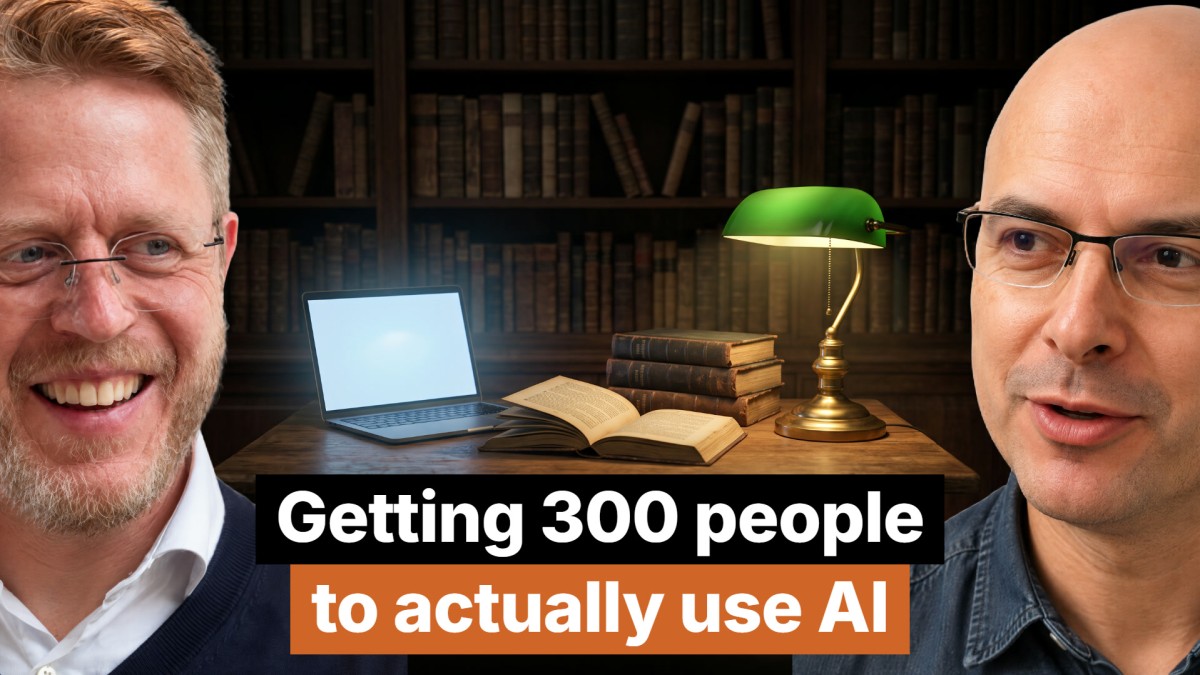
Ivar Holm is a director at Norway's National Archives. He has written a book "Working with AI"
He also has a bachelor's in industrial design, a master's in computer science, and a PhD in architecture and design. He has led technology teams and companies for 20 years.
And he is just as surprised as I am.
Everyone wants the change. No one wants to change.
"It has been slower than I anticipated," he told me. "I am baffled why."
Some people race ahead. Most don't engage with the tools the way he expected. He tried making showing examples and running demos. None of that moved people much. What moved them was using the tools themselves.
I've seen the same thing, and it surprised me just as much.
Everyone wants the change.
No one wants to change themselves.
I expected people to forget their old way of working and start working with AI. I was wrong about how fast habits move. They move one person at a time, and only when that person does the work with AI, not when they watch someone else do it.
Three tracks and three lanes
Ivar runs his rollout in three tracks.
- Track one is everyday use: the chat tools and Copilot, in your daily work.
- Track two is the full depth of Claude, Codex, and ChatGPT.
- Track three is for developers and operations, using AI to build software in a safe, structured way.
They ran it on the leadership team first. "The key here is not to talk about AI, but to actually do it."
I also work with three lanes, which made this part of the conversation fun. But we cut the problem in different directions.
His tracks are levels of complexity. Each person climbs as far as their work needs.
My three lanes are types of project:
- People: how each person uses AI in their own work.
- Automation: the processes a team or department runs together.
- Offering: AI as part of what customers and partners pay for.
Two different maps, and both start in the same place: with people using the tools themselves.
The worst programmer in the company
This is the part of the conversation I keep thinking about.
Ivar calls himself the worst programmer in his organisation. He still builds full applications with AI after work, backend and frontend.
He doesn't read the code. He tests it.
He has the AI write lots of tests. He tests on a real phone, on a Mac, and on the website. He set performance goals and stress tested the app, and the AI brought in a stress-testing tool he had never heard of.
He thinks not being a strong developer is actually his advantage. He has no habit telling him to check every line by hand.
After about two months, he gave ChatGPT the numbers on what he had built and asked how long a team would need to build the same thing. The answer was 40 times longer.
"In management, if we get 20% more, it's fantastic," he said. "One to 40 is mind blowing."
This one hit close to home.
After 20 years of writing code, I stopped writing code.
What I do now is spend time on testing and quality assurance. I make the system so strict that AI can't get a mistake. The code became the output, the artifact, but not the most important thing.
Ivar got there without 20 years of habits to unlearn. I had to unlearn mine.
He wrote a book - but not actually wrote it
Ivar also wrote a book about using AI at work.
Except, as he puts it, he didn't.
"I feel uncomfortable saying that I have written a book, because I don't think I've written a single word. It may be more appropriate to say I prompted the book."
It still took him many nights with very little sleep. He read everything, decided what went in, and changed it again and again.
Then a colleague read it and told him: "It's like having you next to me."
I've read a few chapters. I could hear Ivar in them. Short, concise, his way of laying things out. I never once thought "AI wrote this."
This is the new way of writing.
You don't type the words anymore. You guide a personal copywriter. It makes the words sound like you, says what you meant to say, and makes it easy for the reader to follow.
It's the same thing we did with code. We wrote code for the machine and for other developers to understand. Now AI understands it well enough to write it better than we did.
But someone still has to know what they mean.
The person behind the words is still there. You can read them.
I'll admit I'm a bit jealous. I planned to write my own book as a summer project. Every change turned into another loop, and every loop took more mental energy than I had. Ivar finished his.
The harness matters as much as the model
At the end, I asked Ivar for one piece of advice from his book.
His answer was about what surrounds the model, more than the model itself: what it can see, which tools it gets, where it can test its own work. He calls that the harness, and he explained why he prefers that word to "context."
That's where the full conversation goes next.
Categories: : AI
"Applicable Bytes" newsletter
Get The Applicable Bytes here: Growth in programming, technical leadership & AI.